
Martin County Deed Record Types
Every search of Martin County deed records starts with the instrument type. Each form signals a different path of transfer. A recorded deed proves the document was filed and shows what its text actually says. It cannot prove that no competing or unrecorded interest exists. Read the parties, the date, and any stated consideration as one package. Include the legal description, reservations, signatures, acknowledgments, and the citation to the prior recording. Context is everything here.
| Deed Type | What It Does | Common Use |
|---|---|---|
| General warranty | Conveys the stated interest with broad covenants | Conventional sale |
| Quitclaim | Conveys only the interest the grantor may hold | Interest cleanup or family transfer |
| Fiduciary or executor | Conveys through an estate authority | Probate property |
| Commissioner or sheriff | Conveys under court or official authority | Judicial transfer |
| Affidavit of descent | Records facts tied to inherited title | Heir and estate trail |
Mortgages and liens are encumbrances, not deeds. Each one needs a later release, filed separately, to clear the record. Plats map divisions of land, while deeds convey interests in the land those maps describe. The Martin County Clerk indexes all of these groups through the Legal Records Department. Read each instrument on its own terms. A stated consideration may explain a transfer, but it may not equal present value. A tax mailing name can point you toward a deed. Yet it proves nothing about the full legal interest. Match the tract description before linking any two records.
Martin County CCLIX Time Split
The Martin County Clerk records page reports deeds and mortgages indexed in CCLIX back to 1966, with most instrument filings viewable online through eCCLIX from January 2004 forward. Those two statements describe different layers of access. The index can still return an older citation even when the image itself cannot be viewed from home.
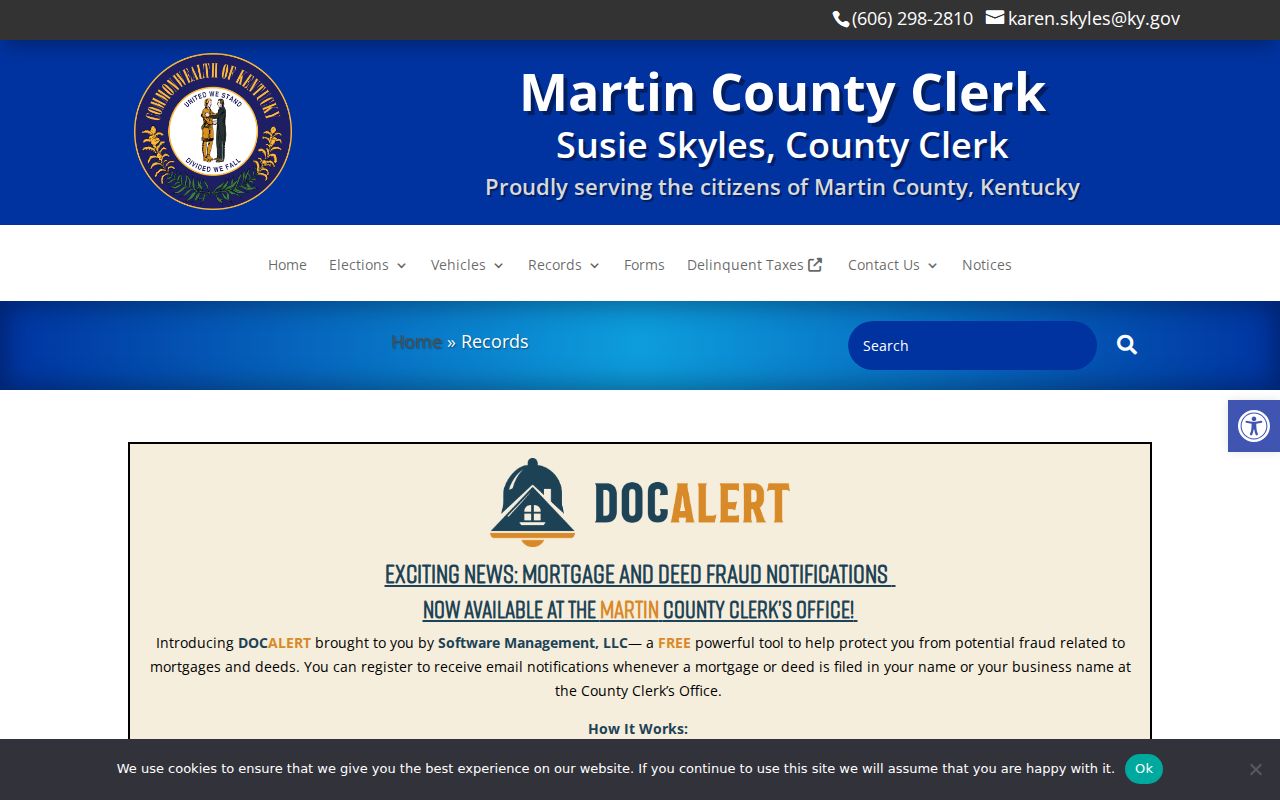
The official page lists eCCLIX, office microfilm, record categories, and Doc Alert as separate access tools. Save the exact book, page, instrument type, parties, and date from any hit. Those details let staff retrieve the source.
Search Fields for Martin County Deeds
The clerk and eCCLIX document their own search controls and output fields. Those are the ones to rely on. Name spelling matters most. Search individuals with surname variants, initials, and both party roles. Search a trust, estate, or company under its exact recorded wording. A shortened corporate name can hide the filing you need.
| Field | Use in the deed index | Capture from a hit |
|---|---|---|
| Grantor | Find conveyances made by a party | Name and role |
| Grantee | Find property received by a party | Name and role |
| Date range | Bracket a known transfer period | Recording date |
| Document type | Separate deeds, liens, releases, mortgages, and plats | Indexed category |
| Book and page | Request the image or copy | Permanent citation |
An address or parcel number can help staff identify a tract, but the historic deed index remains a party-name system at heart. Take the legal description from the image itself. A shortened index label is no substitute.
Martin County Grantor-Grantee Chain
A chain of title is the ordered sequence of transfers affecting one tract. Begin with the newest confirmed deed rather than the assessment name alone. The current owner should appear as grantee on the acquiring deed. That deed's grantor becomes the prior-owner clue. The source-of-title clause often cites the earlier book and page directly. This makes the next backward step simple.
- Find the current party as grantee and open the acquiring deed.
- Copy the grantor, source-of-title citation, legal description, and exceptions exactly.
- Search that grantor as an earlier grantee, then compare the land descriptions.
- Repeat backward, shifting to microfilm and deed books before the online range.
- Grantor
- The party conveying the stated interest.
- Grantee
- The party receiving the stated interest.
- Chain of title
- The linked sequence of instruments for the same land.
- Book and page
- The permanent recording citation used to retrieve an instrument.
Martin County Deeds Before 1966
The online index cutoff is not where Martin County land history begins. The clerk holds office microfilm. KDLA's county inventory lists deeds from 1870 through 2017. It also lists surveys from 1875 through 1937, wills from 1861 through 2017, and selected nineteenth-century assessment books. Martin County formed in 1870 from parts of Floyd, Johnson, Lawrence, and Pike counties. An early chain can therefore lead into a predecessor county's records.
The KDLA research guides explain deed-book and microfilm research in depth. When modern addresses fail, lean on watercourses, roads, adjoining owners, acreage, and district labels. Some transfers look nothing like an ordinary sale. A will, probate file, commissioner deed, or sheriff deed can bridge them.
Note: No verified Martin County courthouse-fire loss was found, so document any gap without assigning it to an unproven fire.
Source-of-Title Clues in Martin Deeds
The source-of-title clause points backward in the chain. It leads from a deed to the instrument that gave the grantor the land. That makes it the fastest backward link in a Martin County deed search. Copy the citation exactly. Then verify that acreage, the named watercourse, adjoining owners, tract number, and reservations all match. Similar party names alone never establish that two deeds concern the same parcel.
Rural descriptions may skip street numbers entirely. They may rely on a branch, creek, ridge, road, or neighboring landowner instead. Official Inez sources pair Route 40 with Tomahawk and Route 908 with Coldwater Road. Both road forms deserve a place in your notes. Survey reels can help interpret older calls. Only a licensed survey can settle a present line, though.
Liens Beside Martin County Deeds
Any deed-chain review should sweep several claim types. Check for mortgages, releases, mechanic liens, state and federal tax liens, and lis pendens under the same names. A lis pendens is a filed notice that litigation may affect the land. A release is the later document that may discharge a recorded claim. Never assume a claim was released just because the loan is old. The clerk's published 2020 fee schedule separates instrument categories. It lists a mortgage at $80, a plat at $50, and a state tax lien at $5. Federal and mechanic liens run $46. A will costs $47. Those figures are recording fees. They do not promise the price of a particular copy or online plan. Confirm current charges with the office before you pay.
Martin County Doc Alert
Martin County residents can sign up for Doc Alert at no charge. The clerk's service watches for deeds and mortgages recorded under a name you choose. The name can be personal or business. Registration takes just a name and an email address. When a matching instrument hits the deed records, the system sends a notice. An unexpected filing comes to light quickly instead of sitting unnoticed.
Alert, not a block. Doc Alert does not stop recording, clear title, release a lien, or prove that a match affects the registrant's parcel.
Open the recorded deed or mortgage itself. Check the land description, the parties, and the recording details against what you expected. If anything looks wrong, contact the clerk promptly so the filing can be corrected.
Request a Martin County Deed
For online deed images, you need eCCLIX account access. Registration and payment are handled by steps the vendor describes. Subscription and electronic invoicing follow the clerk's steps too. Searching the public records and indexes in the office is free, according to the county. Staff can also pull a document from an exact citation. The clerk accepts mail, fax, email, and Open Records requests for non-exempt records.
Say whether you want a plain or certified copy. Provide the grantor, the grantee, the instrument type, the date, and the book and page. Confirm the current copy charge before you pay. Kentucky Open Records Act guidance gives the agency time to identify responsive records. It also lets the agency apply exemptions. But it will not convert a vague request into a title search. Narrow your request to the named instruments you actually need.
Recorded, not guaranteed. Martin County deed records show filed instruments. They are not a title opinion, and unrecorded interests or indexing errors may exist.