
Trace Martin County Former Owners by Transfer
Every backward chain starts with one solid deed reference, then steps back transfer by transfer. The table works as a template for your own timeline. It is not a real parcel's history. Pull each entry from the Martin County Clerk index or the deed image itself. Keep the legal description fixed while names and mailing addresses shift from row to row.
| Transfer date | Grantor to grantee | Deed type | Reference to retain |
|---|---|---|---|
| Newest recorded transfer | Prior owner to current grantee | As indexed | Instrument or book/page and recording date |
| Earlier acquisition | Earlier grantor to the prior owner | Warranty, quitclaim, fiduciary, commissioner, sheriff, or other stated type | Source-of-title citation and legal description |
| Estate or court transfer | Decedent, fiduciary, commissioner, or sheriff to grantee | Affidavit, fiduciary deed, commissioner deed, or sheriff deed | Probate or court case plus recorded instrument |
| Historic deed-book step | Indexed grantor to grantee | As written in the book | Volume, page, date, acreage and survey calls |
This discipline keeps you from borrowing the history of a namesake owner or a neighboring tract. Dates, party names, and book-page citations only count when the description matches the subject land.
Reconstruct Martin County Former Owners Backward
The Martin County Clerk indexes deeds and mortgages in CCLIX back to 1966. Most instrument filings from January 2004 forward are online. Older records sit at the counter. The office microfilm carries the rest. Search both sides of every transfer, grantor and grantee alike.
- Locate the latest deed by its present grantee or known instrument reference and verify the parcel description.
- Read the grantor and any source-of-title clause that cites an earlier deed book and page.
- Search that grantor as a grantee in the earlier period, allowing for initials, spelling changes, estate wording, and entity suffixes.
- Repeat the match, and move to deed books or microfilm when the web coverage ends.
- Grantor
- The party conveying the stated interest.
- Grantee
- The party receiving the interest.
- Reverse index
- An index organized by grantee, useful for finding how a seller had acquired the land.
- Chain of title
- The ordered series of transactions connected to one legal description.
- Quitclaim versus warranty
- Different deed forms whose legal effect should be read from the instrument, not assumed from an index label.
Search Martin County Former Owners in H, C, and S Indexes
When an ordinary name search stalls, the KDLA deed-record guide suggests checking special index conventions. An H may point to heirs. A C can mean a commissioner, and an S a sheriff. These flags matter after an estate, partition, foreclosure, or court sale. Any of those events broke a simple buyer-seller sequence.
In an estate problem, search the decedent, the heirs, and the executor or administrator. For a judicial transfer, gather the case number and the order. Add the sale confirmation and the later deed. Keep everything together as one packet. A will may name property yet never complete the conveyance. So hunt for the recorded affidavit, fiduciary deed, commissioner deed, or other final instrument.
Note: A missing personal-name deed may sit in the index under a fiduciary role, entity, heir designation, commissioner, or sheriff.
How Deep Martin County Former-Owner Records Reach
Different layers of Martin County property records reach back different distances. CCLIX covers the deed and mortgage indexes to 1966. KDLA's official land-record inventory lists Martin County deed microfilm from 1870 through 2017. The clerk confirms office microfilm is still on hand. So prior-owner work can continue whenever an online image or account is out of reach.
| Series | Martin County span documented | Best use |
|---|---|---|
| CCLIX deed and mortgage indexes | 1966 forward | Find party and instrument references |
| eCCLIX instrument images | Most filings January 2004 forward | Read recent recorded documents through an account |
| KDLA deed microfilm | 1870-2017 | Extend the deed chain through historic books |
| KDLA tax assessment books | 1870-1874, 1879-1884, 1886-1892 | Bridge early ownership clues, with listed gaps preserved |
| KDLA surveys | 1875-1937 | Interpret metes-and-bounds, roads, branches, and adjoining owners |
| KDLA wills | 1861-2017 | Follow estate and devise leads |
Mind the cutoff. The online deed index reaches 1966, but older former owners require deed books, office microfilm, or archival reels. Never fill a gap by inference.
Bridge Early Martin County Former Owners with Tax Books
Before roughly 1890, deeds may not supply a tidy prior-recording citation. KDLA guidance steers researchers toward tax material as a bridge. A tax assessment book can show the taxpayer, acreage, district, and year. That may be enough to narrow the next deed-index search.
A tax listing is not title proof, though. Weigh the taxpayer and acreage against deeds on both sides of the gap. Check survey calls, adjoining owners, and estate records too. The KDLA inventory shows missing year spans in the Martin County tax series. Record those gaps as facts rather than smoothing over them.
Martin County Surveys Preserve Older Place Clues
Former-owner research often outlives a street address. Martin County survey reels from 1875 through 1937 can preserve creeks, branches, roads, courses, distances, acreage, and adjoining-owner names. Those terms may connect a nineteenth-century deed to a modern tract. Today's postal label may not do the same.
Write every geographic call exactly as recorded. Do not silently swap Route 40 for Tomahawk or Route 908 for Coldwater Road. Both paired forms appear in official local material. Search each form. Then test with an official map or recorded plat whether the same land is in play.
Note: A survey clue can explain a deed description. But only the recorded transfer chain fixes the sequence of prior owners.
Continue Martin County Former Owners Offline
At the clerk counter, request a deed by grantor or grantee. Give an approximate year, book-page, instrument number, or legal description. Ask whether the image lives in the office, online, on microfilm, or at another facility. Searching public records and indexes in the office is free. eCCLIX requires registration and paid access.
For an archival reel, start with the KDLA Martin County inventory. Supply county, series, year, volume, and page. The Kentucky Historical Society can add map and manuscript context. FamilySearch's Kentucky collection list is a discovery lead for further deed records. Access to every Martin County image varies.
Start Martin County's Historic Chain at the Clerk
The Martin County Clerk records page lays out the modern index, microfilm, and instrument categories that launch a backward chain of deed records.
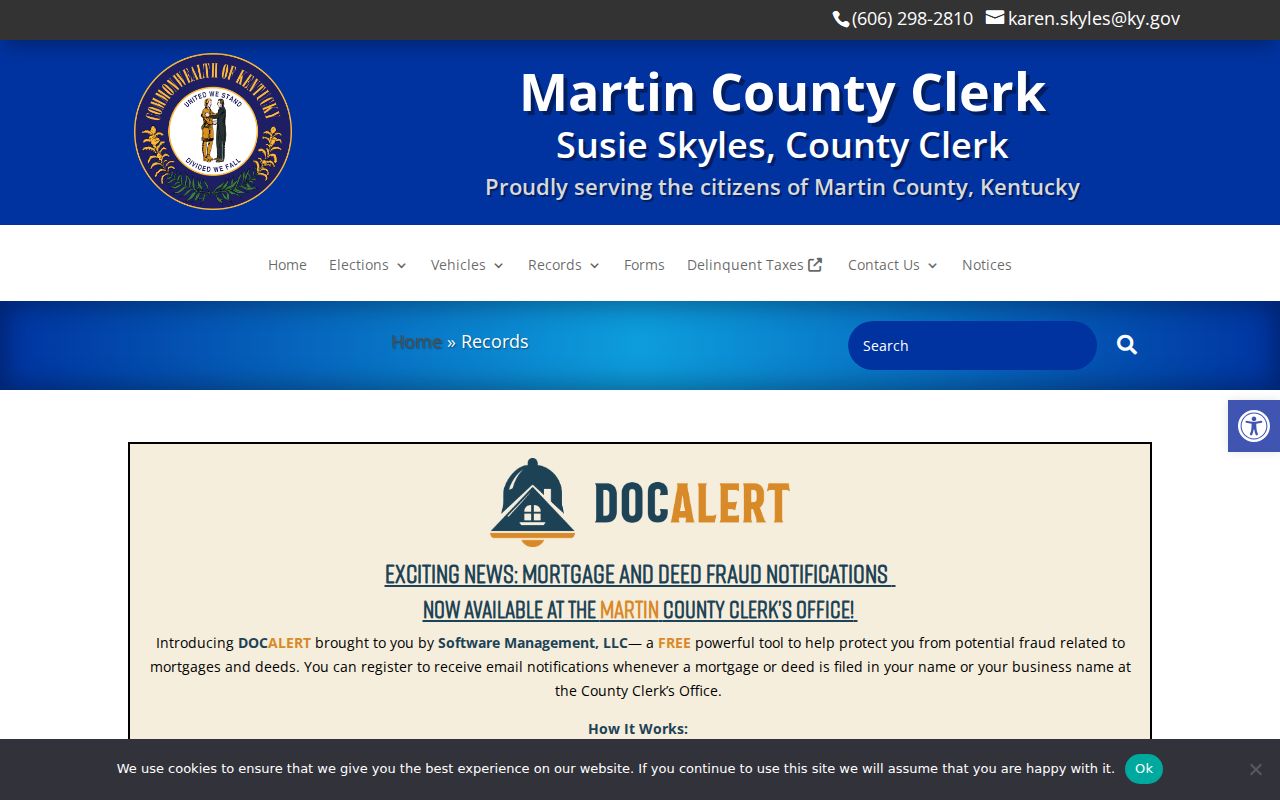
That page gives the access point, not a sample deed. Every former-owner name still must attach to a real index reference and a matching legal description.
Log Gaps Between Martin County Former Owners
Each completed link deserves a full record: grantor, grantee, deed type, execution and recording dates, instrument or book-page reference, legal-description wording, acreage, and source-of-title citation. Note where the image sits, too. Log failed searches as well. Give every miss its own line with the spellings tried, initials used, date range, grantor or grantee direction, the H/C/S marker, and which series you checked.
A chain reaching 1870 should be flagged for predecessor-county or Kentucky Land Office material. Either could explain an earlier origin. When the chain stops later, ask a simple question instead. Is the book at the clerk, on office microfilm, at KDLA, or moved to another facility? Martin County has no verified courthouse-fire explanation. A missing volume therefore gets no dramatic cause without evidence.
The log has one more job. It stops a tax payer, adjoining owner, obituary relative, or business agent. Guesswork alone should never promote anyone into the chain. Those names can point the next search. Still, only a matching conveyance, a final court instrument, or another legally effective record should ever close a link in Martin County property records.
Record the End of a Martin County Ownership Chain
Martin County formed in 1870. A tract older than the county may need a predecessor-county or Kentucky Land Office patent lead. The local series begin after that point. A patent explains the land's early origin. Modern title, though, still rests on the later county chain of deed records. No verified courthouse-fire or destroyed-decade story exists for Martin County. So an unexplained break belongs with the clerk or an archive rather than blamed on a fire.
Keep a gap log. Record the missing years, names tried, index direction, spelling variants, series checked. Also record the custodian's response. That log beats a guessed owner every time. And when a transfer, probate matter, boundary change, or unrecorded interest carries legal weight, a professional title search of the property records may be the right step.
Lawful history research. Former-owner records support title work, estate research, and house history. Do not use them to track, harass, intimidate, or harm a living person.